
In London, a property listing has only a short moment to earn attention. A buyer scrolling through portals, a tenant comparing flats after work or a vendor checking how an agency will present a new instruction will often judge the listing before reading every detail. The first images shape that first impression.
That is why estate agent photography London searches are usually driven by a practical need. Agents do not simply want photographs. They need reliable listing assets that help a property look accurate, prepared and ready for market. They also need a workflow that does not create more administration for negotiators, branch managers or marketing teams.
Poor photography can make a good property feel smaller, darker or less organised than it really is. Over edited images can create a different problem because they may raise unrealistic expectations and lead to weaker viewings. The right approach sits between those two extremes: professional, clear, honest and commercially useful.
For estate agents preparing sales or lettings instructions, photography also connects with other parts of the listing process. Floor plans, EPCs, virtual tours, compliance documents, brochures and video can all affect how efficiently a property goes from instruction to live listing. Property Motion supports that wider workflow by helping property professionals coordinate professional property photography, technical floor plans, 3D virtual tours and compliance related services from one place.
This guide explains what good estate agent photography should include, how London agents can compare providers and how to build a more efficient listing preparation workflow without relying on scattered suppliers.
What Estate Agent Photography Means in London
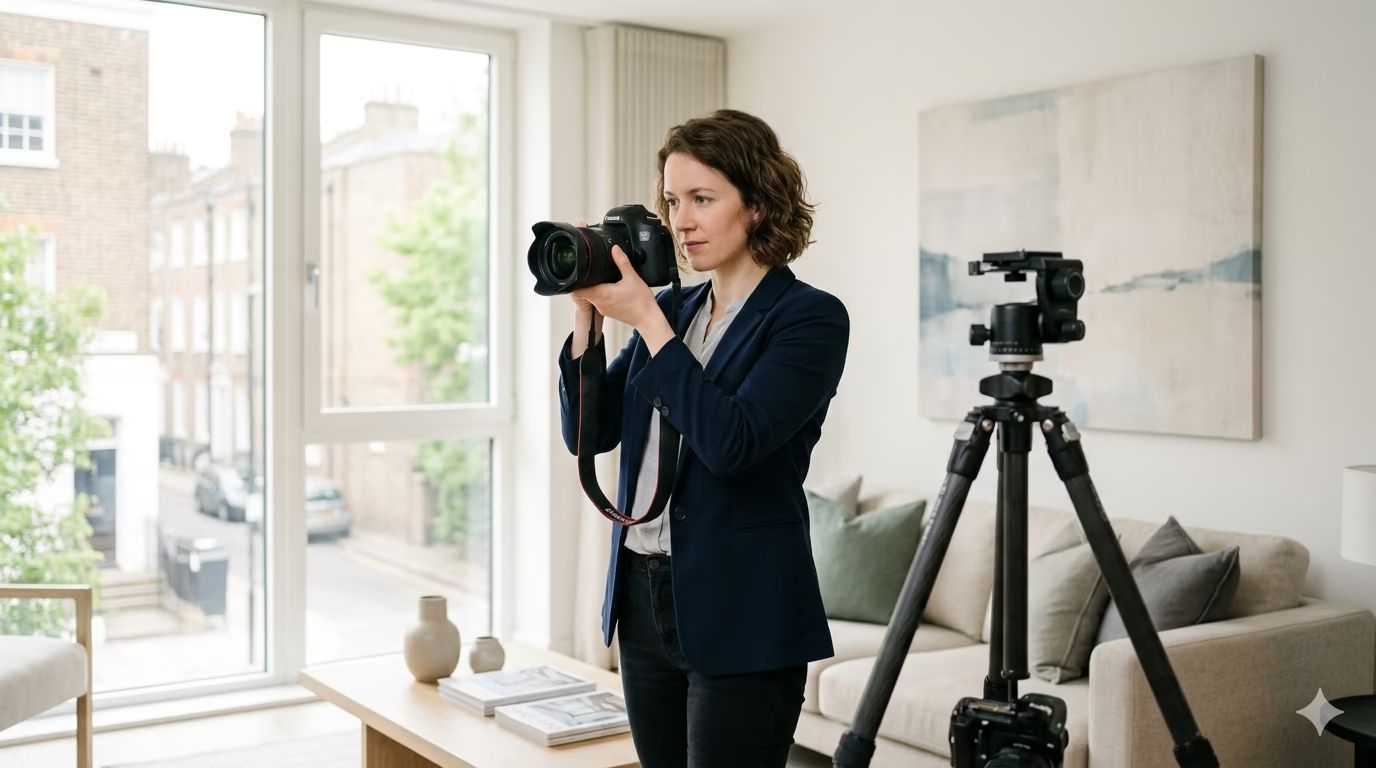
Estate agent photography is the process of creating professional images for a property listing, sales campaign, letting advertisement, brochure, social media post or vendor presentation. In London, it often needs to work across several audiences at once: buyers, tenants, landlords, sellers, investors and internal agency teams.
The goal is not to make every property look like a luxury show home. The goal is to present the property clearly and consistently, so people understand space, light, layout, condition and potential before they book a viewing.
More than taking photos
A professional property photographer should understand how rooms are used, how natural light changes a space, which angles show the layout best and how to avoid misleading compositions. Good photography helps a user answer simple but important questions.
Can I understand the room size? Can I see how the living space connects to the kitchen? Does the bedroom feel usable? Is the garden visible? Are the main selling points easy to recognise?
That practical clarity is especially important for London listings where space, layout and condition can vary widely between period conversions, new-build apartments, terraced houses, maisonettes and mixed-use properties.
Why the estate agent context matters
Photography for estate agents has a different purpose from interior design photography. A magazine shoot may focus on mood, styling and atmosphere. Estate agent photography needs to support a commercial property decision. It should make the listing easy to compare, easy to understand and suitable for portals.
For agents, this means the images must be attractive but also useful. A beautifully edited corner detail does not replace a clear living room image. A wide lens can help show space, but unrealistic distortion can create trust issues. Bright images are helpful, but over-bright editing can hide important condition details.
The practical standard
The strongest estate agent photography usually feels clean, balanced and believable. It should help a buyer or tenant decide whether the property is worth viewing, not leave them confused when they arrive.
Why Professional Photography Still Matters for Estate Agents
Some agents now ask whether professional photography is still necessary when mobile phone cameras are so strong. The question is understandable, but it misses the operational value of a professional shoot.
A phone can take a good image in the right conditions. A trained property photographer brings consistency across rooms, listings, branches and property types. That consistency matters when an agency is trying to protect brand quality across many instructions.
Professional photography also reduces the hidden time cost of listing preparation. When negotiators take photos themselves, they may need to return to the property, retake poor images, edit files, resize images for portals and explain inconsistent presentation to vendors. Those tasks can cost more time than expected.
What professional photography helps solve
For estate agents, professional photography can help with:
- Creating a stronger first impression on property portals
- Making rooms easier to understand before a viewing
- Keeping listing presentation consistent across offices
- Supporting vendor confidence during instruction
- Reducing the need for repeated visits to correct poor images
- Combining photography with floor plans, virtual tours and compliance services where practical
This does not mean photography alone guarantees more enquiries or a faster sale. Search demand, pricing, location, property condition, market timing and agency follow up all matter. Photography is one part of a wider listing process.
A realistic example
Consider a two-bedroom flat in East London. The property has a good layout but limited natural light in the hallway and one bedroom. A rushed phone shoot may make the property feel darker than it is. A professional photographer can plan the order of rooms, balance exposure, use suitable angles and deliver a consistent set of images that better explains the space.
The property is still the same property. The difference is that the listing becomes easier to read visually.
What Should Be Included in an Estate Agent Photography Shoot
A good estate agent photography service should be clear about what is included before the appointment. Agents should not need to guess whether editing, image selection, room coverage or delivery format is part of the price.
At minimum, a property photography shoot should provide a usable set of images that cover the main internal and external areas of the property. Depending on property type and package, this may include reception rooms, kitchen, bedrooms, bathrooms, garden, balcony, exterior, entrance and important features.
Core image coverage
A typical property shoot may include:
- Front exterior where access and conditions allow
- Main reception or living space
- Kitchen and dining areas
- Bedrooms
- Bathrooms
- Garden, terrace or balcony
- Relevant building or development features
- Important details that help explain value or condition
Agents should decide in advance whether the property needs a basic listing shoot, a premium marketing shoot, twilight images, aerial images, video or a 3D tour. A studio flat and a five-bedroom townhouse should not be planned in the same way.
Editing and delivery
Editing should improve clarity without changing the property in a misleading way. Basic correction may include exposure balancing, vertical alignment, colour correction and cropping for listing use. More advanced editing, such as object removal, sky replacement or virtual staging, should be used carefully and disclosed where appropriate.
GOV.UK guidance around material information in property listings highlights the importance of relevant information being available to consumers. Photography is not a substitute for listing information, but accurate visual presentation helps support a clearer listing experience.
Before approving the final image set
Before images are uploaded to portals, an agent should check whether the sequence makes sense. The best lead image should attract attention, but the full set should still guide users through the property logically.
Need help with this service in London?
Tell us your postcode and our team will confirm pricing, availability and the best
certificate package for your portfolio.
Estate Agent Photography London: What Makes the Market Different
London creates specific challenges for estate agent photography. Properties can be compact, high value, time sensitive and operationally complex. Access may need to be arranged around tenants, building concierges, parking limits, keys, vendors, landlords or block management rules.
That is why London agents often need more than a photographer. They need a reliable process.
Property types are highly varied
A London photographer may work on a studio flat in Zone 1 in the morning, a Victorian conversion in North London at midday and a family house in South West London later the same day. Each property needs a different approach.
Compact flats need careful angles and honest space presentation. Period homes often require attention to character features, fireplaces, bay windows, ceiling height and natural light. Premium apartments may need images that show concierge areas, views, balconies and development amenities where access is permitted.
Access can be the real constraint
The most common operational challenge is not the camera. It is coordination. Keys may be held at a branch. A tenant may only be available during a narrow time window. Parking may be difficult. A vendor may want minimal disruption. A property manager may need multiple services completed in one visit.
This is where a coordinated workflow can reduce friction. Property Motion is designed to help agents and landlords organise listing and compliance services in one place, including photography, floor plans, virtual tours and related property services.
Photography, Floor Plans and Virtual Tours Work Better Together
Estate agent photography is often treated as a separate task. In practice, the strongest listing preparation usually combines several assets.
Photography shows the look and feel of the property. A floor plan explains the structure and layout. A virtual tour helps remote users explore the space before arranging a viewing. Video can support social media, premium marketing and agent brand visibility.
The listing asset stack
A stronger London listing may include:
- Professional photography for portal visibility
- A 2D or 3D floor plan for layout clarity
- A 3D virtual tour for remote viewing and qualification
- Short video or vertical clips for social media
- EPC and compliance documents where required
- Brochure or branded marketing assets for premium instructions
Estate agents can learn more about layout support in our guide to floor plans in London and broader listing strategy in our guide to property marketing services in London.
When one visit helps
Coordinating services can be useful when the same access arrangement can support multiple outputs. For example, photography and a floor plan may be arranged during the same appointment where operationally suitable. A virtual tour may also be planned alongside the shoot depending on the property, equipment and service availability.
This does not mean every service can always be completed in one visit. Requirements may depend on property type, access, service scope and available professionals. The value is in reducing scattered administration where possible.
A simple planning question
Before booking only photography, ask: What else will this property need before it can go live or stay compliant?
Want to save time?
Book your property service with Property Motion and let our team confirm the right
service, availability and next steps.
How to Compare Estate Agent Photography Providers
Not all photography providers offer the same level of service. Some are individual photographers. Some are agency suppliers. Some offer combined marketing assets. Others focus mainly on speed.
Estate agents should compare providers based on delivery quality, consistency, communication and workflow, not only the lowest price.
| Comparison point | What estate agents should check | Why it matters |
|---|---|---|
| Image quality | Review recent examples across different property types | Consistency protects brand presentation |
| Service scope | Check whether floor plans, video or virtual tours are available | Multiple assets may be needed for a complete listing |
| Turnaround | Confirm realistic delivery expectations | Delayed images can delay portal launch |
| Editing approach | Ask what edits are included and what costs extra | Transparent editing avoids confusion later |
| Access handling | Check how appointment details and keys are managed | Operational reliability matters in London |
| Compliance awareness | Ask whether EPC and related services can be coordinated | Agents often need marketing and compliance readiness together |
Questions to ask before booking
Agents should ask practical questions such as:
- How many edited images will be delivered
- What image formats and sizes are provided
- Whether image rights allow portal, brochure and social media use
- Whether a floor plan can be arranged at the same time
- Whether a virtual tour is available for this property type
- How reshoots or access problems are handled
- Whether pricing changes by property size, image count or add ons
A provider that can answer these clearly is usually easier to work with than one that gives vague package descriptions.
Preparing a Property Before the Photographer Arrives
Even a skilled photographer can not fix every preparation issue. A property does not need to be perfect, but basic preparation can significantly improve the final result.
Estate agents should provide vendors, landlords or tenants with a simple preparation checklist before the appointment. This reduces wasted time and avoids preventable image problems.
Preparation that usually helps
Before the shoot, the property should ideally be clean, tidy and accessible. Curtains or blinds should be adjusted for light. Worktops should be cleared. Beds should be made. Bins, washing, personal paperwork and visible clutter should be reduced where possible.
For rental properties, agents may need to work around occupied homes. In those cases, preparation should be realistic and respectful. The goal is not to create a false version of the property, but to present it clearly.
Small details that affect perception
Small issues can make a listing feel careless. A half-open wardrobe, visible cleaning products, dark hallway, unmade bed or tilted picture frame can distract from the property itself. These are not major problems, but they affect how users read the image.
Best practice before the appointment
Send the occupier a short checklist at least one day before the shoot and confirm access arrangements. That simple step can prevent many common problems.
Common Mistakes Estate Agents Should Avoid
The main photography mistakes are usually not technical. They are process mistakes.
One common issue is booking photography before the property is ready. The photographer arrives, but the property is still cluttered, keys are unavailable or the tenant was not informed. Another mistake is using the same image approach for every property, even when a premium listing needs video, drone or a virtual tour.
Over editing can damage trust
Some editing is helpful. But excessive editing can create unrealistic expectations. If the property looks very different in person, viewings may become less productive and user trust can weaken.
Agents should also be careful with virtual staging, object removal and sky replacement. These tools can be useful when applied transparently and appropriately, but they should not hide material condition issues.
Weak image sequencing
A listing may have good photos but still feel confusing if the sequence is poor. Users need to understand the property journey. Start with the strongest lead image, then move logically through main living areas, kitchen, bedrooms, bathrooms, outdoor space and key features.
The simple test
After viewing the image set, a user should be able to explain the property in one sentence. If they can not understand the layout or main appeal, the listing assets may need improvement.
How Property Motion Supports Estate Agents
Property Motion helps property professionals prepare, present, comply, list and manage property services through a more coordinated workflow. For estate agents, this is especially useful when a new instruction needs several moving parts to be organised quickly.
The platform supports property photography, 2D and 3D floor plans, virtual tours, EPC related services and broader property compliance management. This helps agents reduce the need to chase multiple suppliers separately.
Useful for busy branches
A branch team may have several properties preparing for market at the same time. One property may need photography and a floor plan. Another may need photography, EPC and a virtual tour. A landlord portfolio may need updated compliance records before new marketing begins.
When those tasks are managed separately, small delays can build up. A single coordinated booking path makes it easier to see what has been requested and what still needs to be delivered.
Not a replacement for agency work
Property Motion does not replace the role of an estate agent. The agent still manages vendor relationships, valuation, pricing strategy, buyer communication and negotiation. Property Motion supports the operational work around listing assets and property service coordination.
Where it fits best
Property Motion is most useful when an agent wants reliable property marketing and compliance outputs without adding extra administration to the branch team.
A Practical Workflow for a New London Instruction
A stronger workflow starts before the photographer arrives. Estate agents should think about what the listing needs rather than booking services one by one.
First, identify the property type and marketing level. Is this a standard rental listing, a premium sales instruction, a vacant property, a tenanted flat or a developer unit? Next, decide which assets are required. Photography may be enough for some listings, but others may need a floor plan, virtual tour, video or compliance services.
Then confirm access, occupier expectations and delivery deadlines. Finally, check all assets before the listing goes live.
Example workflow
A practical sequence may look like this:
- Confirm property address, access and contact details
- Select photography and any additional listing assets
- Check whether EPC or other compliance items are required
- Send a preparation checklist to the occupier or vendor
- Complete the appointment where access allows
- Review delivered images and floor plan
- Prepare the listing with clear information and accurate media
- Save outputs for future reference or renewal workflows
This workflow supports the Property Motion approach: one property, one coordinated booking, multiple outputs where suitable.
Final Checklist for Estate Agent Photography in London
Before booking estate agent photography in London, agents should check whether the provider can support the full listing requirement rather than only the camera work.
- Confirm how many edited images are included
- Check whether floor plans can be booked at the same time
- Ask whether virtual tours or video are available
- Confirm image delivery time and format
- Prepare the property before the shoot
- Check image usage rights for portals and social media
- Review the final image sequence before publishing
- Coordinate EPC and compliance services where relevant
The best provider is not always the one with the lowest headline price. For estate agents, reliability, image consistency and workflow clarity are often more valuable than a small saving on one appointment.
Summary: Better Photography Starts With Better Preparation
Estate agent photography in London works best when it is treated as part of a full listing preparation process. Good images matter, but they are more effective when they sit alongside clear floor plans, accurate property information, suitable compliance documents and a smooth booking workflow.
For buyers and tenants, professional images help explain the property. For vendors and landlords, they show that the agent is taking presentation seriously. For branch teams, a reliable photography workflow reduces repeat admin and helps properties move from instruction to listing with fewer avoidable delays.
Property Motion helps estate agents, letting agents and landlords coordinate property photography, floor plans, virtual tours, EPCs and compliance services through one practical workflow. That makes it easier to prepare properties for market while keeping the process clear and organised.
To plan your next property shoot, request a quote or explore the services that can support your listing.
Keep reading
Property Photography London Cost Process and Listing Tips

Floor Plans London: 2D and 3D Property Plans for Better Listings

Property Marketing Agency London for Agents and Landlords

3D Virtual House Tour London: A Practical Guide for Agents and Landlords
Frequently asked questions
Estate agent photography is professional photography created for property listings, sales campaigns, letting adverts, brochures and property marketing. It helps buyers and tenants understand the property before arranging a viewing.
Estate agents use professional photographers to improve listing presentation, maintain consistent image quality and reduce the time spent retaking or correcting poor images. Professional photography should make the property clearer and easier to assess.
London photography can be more operationally complex because of compact properties, high listing competition, access restrictions, tenant availability, parking limits and varied property types. A reliable workflow is important.
In many cases, yes. Floor plans help users understand layout, room relationships and space. They work well alongside professional photography and can reduce confusion before viewings.
They can often be coordinated together where property access, service availability and property type allow. Property Motion helps agents organise compatible services through one workflow.
No. Photography can improve listing presentation, but enquiry volume also depends on price, location, demand, property condition, listing copy and market conditions. Avoid any provider that guarantees results from photography alone.
The property should be clean, tidy and accessible. Worktops, floors, beds, bathrooms and main rooms should be prepared before the photographer arrives. A simple preparation checklist can improve the final result.
Property Motion helps estate agents coordinate professional property photography with related listing and compliance services such as floor plans, virtual tours, EPCs and compliance management.
Need estate agent photography and listing assets
Property Motion helps estate agents, letting agents and landlords organise photography, floor plans, virtual tours, EPCs and other property services through one coordinated workflow.